
Guide to Malta's Firearm Legislation History
Malta has some of the most structured firearms rules in Europe. There's a license for each activity, every applicant is trained and tested, and a dedicated board reviews each application.
This guide explains how the law got here, from the 1931 Arms Ordinance to today's Arms Act, and sets out the main rules every license holder in Malta should know.
This guide is general information, not legal advice. Requirements can change, so always confirm with the Police Weapons Office.
A short history
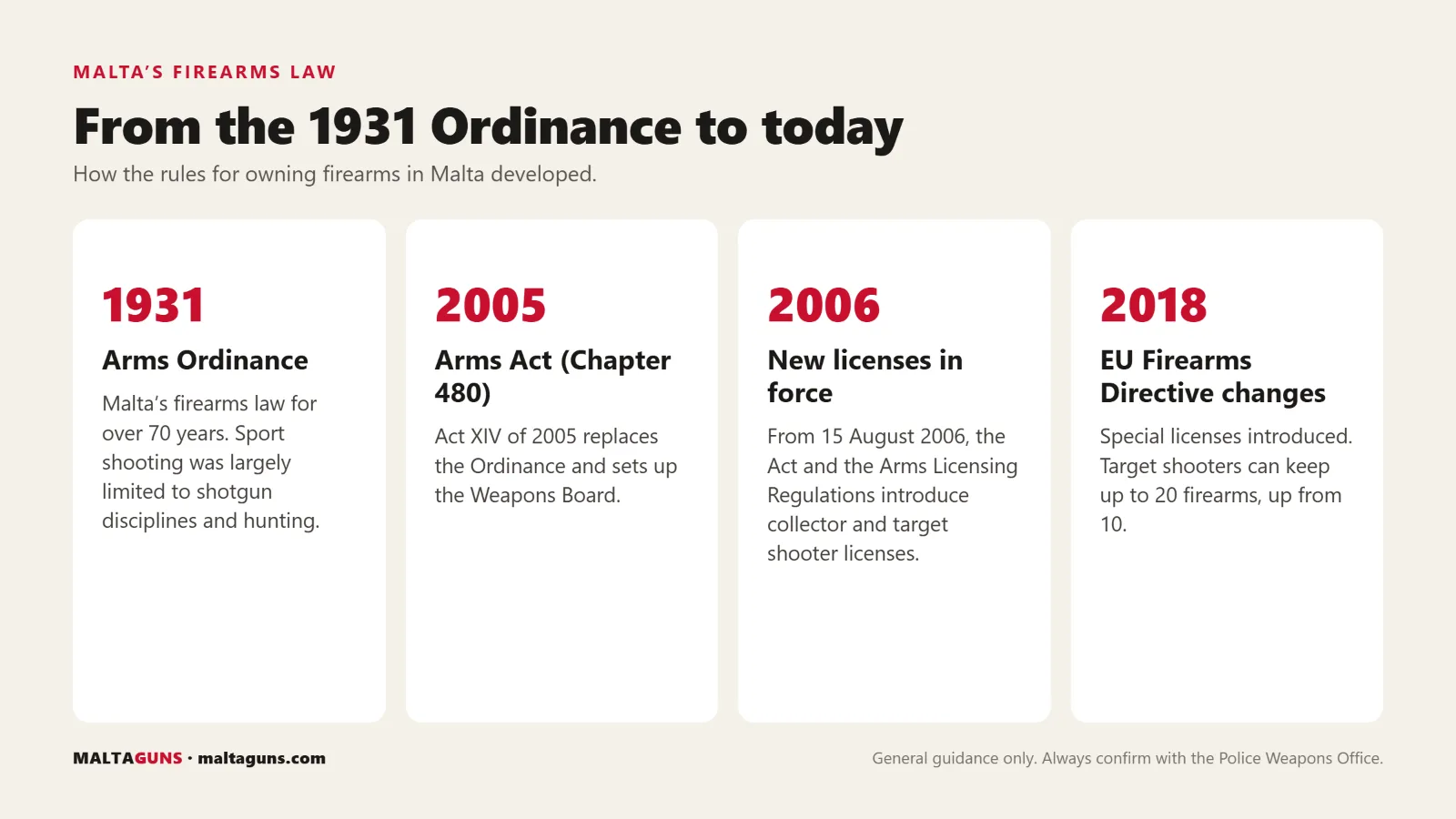
1931: the Arms Ordinance
For more than 70 years, firearms in Malta were governed by the Arms Ordinance of 1931, passed under British rule. Private ownership was tightly limited, and sport shooting was mostly restricted to shotgun disciplines and hunting.
2005–2006: the Arms Act
The Arms Act (Act XIV of 2005), now Chapter 480 of the Laws of Malta, replaced the Ordinance. It came into force on 15 August 2006, together with the Arms Licensing Regulations.
The Act opened up legal collecting and target shooting through new license types, and set up the Weapons Board, which includes representatives of the Police, the Armed Forces and shooting and collecting organisations. The Board reviews license applications and advises the Commissioner of Police.
2018: EU Firearms Directive changes
Amendments brought Malta's law in line with the revised EU Firearms Directive. They introduced the special licenses for firearms and magazines above the standard limits, and raised the number of firearms a target shooter can keep from 10 to 20.
How licensing works today
You can't simply apply for a firearm in Malta. For the standard target shooter and collector licenses, the route is:
Check you're eligible: at least 18, no criminal convictions, a clean police conduct certificate and a medical certificate.
Join a club and complete a license course.
Get a recommendation letter from your club.
Apply for the test at your local police district. No firearms license can be applied for online.
Pass the police test, including the Normal Safety Procedure (NSP).
Collect and pay for your license at your local police station, then renew it every year.
Our guides to the Target Shooter License and the collector's licenses go through each step. 👉 Find a club on our clubs page.
License types
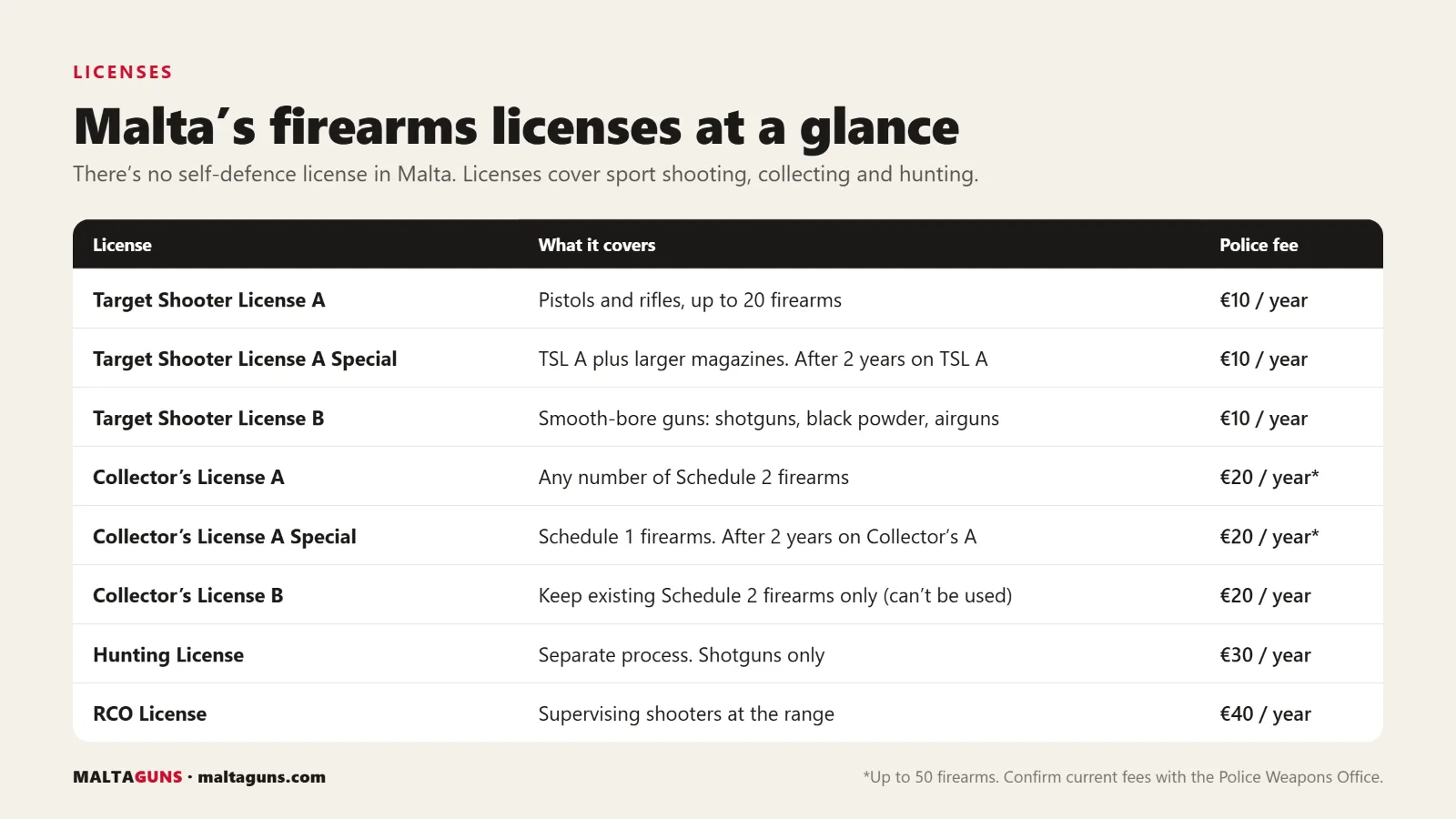
Target Shooter License A (TSL A): pistols and rifles, up to 20 firearms, with magazines of up to 20 rounds for pistols and up to 10 rounds for rifles.
Target Shooter License A Special: larger magazines, for active shooters who've held a TSL A for at least two years.
Target Shooter License B (TSL B): smooth-bore guns only: shotguns, black powder guns, airguns and crossbows.
Collector's License A: any number of Schedule 2 firearms.
Collector's License A Special: Schedule 1 firearms, generally automatic firearms from 1946 and earlier, after at least two years on a Collector's License A. These can't be fired with live ammunition.
Collector's License B: for keeping existing Schedule 2 firearms, usually inherited ones. They can't be used, and no more can be bought.
Hunting License: a separate license with its own process.
Range Conducting Officer (RCO) License: for supervising shooters at the range.
Antique firearms made before 1900, deactivated firearms and replicas don't need a license, but they must still be registered to the owner.
No self-defence license
Malta has no self-defence license. Firearms licenses cover sport shooting, collecting and hunting only, and none of them allows you to keep or carry a firearm for protection. There are very rare exceptions for members of the police or security teams, which follow a completely different channel.
Key rules for license holders
Storage: firearms must be kept so they can't fall into anyone else's hands. They're kept unloaded, locked and separate from ammunition at the premises named on your license.
Where firearms are kept: at the residence where your ID card is registered. For temporary storage anywhere else, speak to the Police first and tell them which firearms, why, and the security measures in place.
Moving house: tell the Police at least 15 days before your firearms move to new premises.
Loss or theft: report it to the Police within 24 hours of finding out.
Transfers: every change of ownership goes through the Police, at the Police Depot in Floriana (or normally in Gozo for buyers who live there).
Renewal: every license is renewed every year. Only the Collector's License B can be renewed online, at armi.gov.mt.
Modifications: changing how a firearm works can change its legal category. Don't modify a firearm without checking with the Police first.
Inspections: the Police can inspect how licensed firearms are kept, although this is very rare.
Breaking these rules can lead to your license being revoked and to criminal penalties. Possessing a firearm without a license is a serious offence.
If you've inherited firearms, read our guide to inheriting firearms in Malta and contact the Police Weapons Office promptly.
Official contact: Police Weapons Office
Address: Police General Headquarters, St. Calcedonius Square, Floriana, FRN 1530 (pulizija.gov.mt/en/contact)
Opening hours: Monday to Friday, 7:30 AM – 2:15 PM (closed for a 15-minute break, 12:00 PM – 12:15 PM). Hours may change. Check with the Police before visiting.
Email: weapons.police@gov.mt
Telephone: 2294 2110
Online renewal (Collector's License B only): armi.gov.mt
Requirements can change. Always confirm with the Police Weapons Office.